Our Tallahassee Consultant/Lobbyist, Mixon and Associates, regularly sends analysis and research papers on areas of interest to the school board. Yesterday afternoon, a point paper was sent regarding our budgets for the next year. It is an analysis of the revenue estimating conference report from last week.
While the report points to some areas of encouragement, namely that we look to be on track to have an additional $300Million in General Revenue statewide over the January forecast, there is also concern that other areas of the state budget will be clamoring for additional revenue—potentially leaving K-12 FEFP vulnerable to static funding. From the report:
“This is an austere picture. It is made more difficult because many other budget areas, such as the state university system, had significant impacts in the FY 2012-2013 budget, while $1.063 billion were used to fill FEFP budget holes. Those other budget areas will compete for new resources in FY 2013-2014. In addition, the Legislature recently has been reluctant to allow revenue increases to be realized from local school property taxes. If the FEFP received an increase of $407.3 million, it is uncertain that the cost of student growth and other increases in state required expenses would be covered by that amount.”
The report goes on to illustrate the effects of the recession on funding levels:
It may be instructive to see what has happened to General Revenue since the start of the recession. The table below shows some comparisons.
Fiscal Year and Report Date Recurring Funds Available Non-Recurring Funds Available Total Funds Available
FY 2006-2007
July 12, 2007 $26.6549 Billion $5.3952 Billion $32.0501 Billion
FY 2007-2008
July 12, 2007 $27.5685 Billion $3.6052 Billion $31.173.7 Billion
FY 2012-2013
May 23, 2012 $24.1042 Billion $1.949.0 Billion $26.0532 Billion
During the same time GR funds were decreasing, total local funds available in the FEFP dropped from $9,405,486,287 in the Final Conference Report of April 28, 2008 for FY 2008-2009, to $7,625,433,481 in the Final Conference Report of March 6, 2012 for FY 2012-2013.
The full report with lots of additional information is here
Wednesday, May 30, 2012


Thursday, May 24, 2012
Holiday Weekend DOE Document Dump: Let the Gnashing of Teeth Begin Part I
Charter Schools—the Good News and the Bad News........
Today the DOE dumped a lot of information on the public, just in time for some significant commotion prior to the long Memorial Day weekend. As was the case a few months back and even more recently with the writing test scores fiasco, the data does not look good.
The attached spreadsheet below illustrates data from 3rd grade reading and mathematics which I have downloaded from the DOE site and sorted. I’ve organized third grade reading and math results, then sorted them from highest percentage of proficient sorcerers in each subject to the lowest number.
The scores for the most part are low. Much of this is due to new, tougher scoring and more rigorous standards, which we all knew would be coming.


Teachers are not miracle workers. Schools, teachers, volunteers, administrators, the latest technological gadgetry and educational pedagogy combined with the best of intentions and stacks of Title I money cannot overcome complacent, dispassionate, and apathetic parents.
Those who are familiar with our local communities and schools will see from the chart above that the schools that are scoring the best have parental engagement, input, and “buy-in”—this is a large part of their success!
Many of the schools that have low scores, unfortunately, do not have the same level of parental engagement. This is a chiefly a societal problem—not a scholastic one.
I’m not going to do the usual dissertation on Poverty in our district to explain low scores away, though;
I’m not going to do the usual dissertation on Poverty in our district to explain low scores away, though;
Tuesday, May 15, 2012
No Good Deed Goes Unpunished---School District prevails with Summary Judgment in James Benny Washington Case
From an email sent by Board Attorney Donna Waters this morning:

SCHOOL BOARD MEMBERS - DO NOT ‘REPLY ALL’ – RESPOND ONLY TO ME
Good Morning:
Mr. Hammons' office just advised us that a summary judgment in favor of the School Board has been granted in the Case of James (Benny) Washington v. School Board. This means that the Court found that there were no material facts in dispute, and that based upon those undisputed facts, there was no legal basis on which the plaintiff could win at trial.
I will provide a copy of the court's order to you upon receipt.
Congratulations are due to Mr. Hammons and his staff for this success!
Donna Sessions Waters
General Counsel
Escambia County School Board
75 North Pace Boulevard
Pensacola, Florida 32505
Background…..
At the regular meeting of the Escambia County School Board on December 18, 2007, Superintendent Jim Paul recommended that the board terminate then employee James Benny Washington. After reviewing the entire issue, including looking into the appropriate files and speaking with numerous district administrative personnel with direct knowledge of this employee, I made the difficult decision at that time to not support the termination recommendation. At the regular meeting that December evening, Superintendent Jim Paul was stunned as the board voted down his recommendation and instead allowed this employee to resign.
It became somewhat personal to me, as I made the recommendation that this employee be allowed to resign, which was voted on and passed by the board over the objection of Superintendent Paul.
This employee had some significant issues, including a legal issue in the courts, which would have provided ample support to the termination had the board decided to take that path. My fear in terminating this employee was that an appeal might be successful—and we would then be compelled to bring this person back with back-pay and be “stuck” with him forever. Nobody wanted that. Also, the compassionate side of me felt that to allow him to quit might provide him the spark necessary to get back on track with his coaching/teaching career. I harbored no personal animosity toward this employee; rather, I felt that if he voluntarily quit, as he was pleading with us to allow, then we would have the benefit of a clean break from him. No DOAH hearings, no arbitration, no Union Grievances, nothing. He would be gone, and that would be that. Plus, we would not have to spend oodles of cash fighting him through these grievances, hearings, appeals, or in court because ----he wanted to quit.
To me it seemed so clear.
But I was wrong—at least initially. After James Benny Washington quit, it became one legal fight after another---racking up huge legal bills for the taxpayers of this county to eat in the process. In June of 2009, Washington filed a two count complaint against the School Board in Circuit Court. We let him quit, which he requested, then he sued us. And this has been expensive-- I have requested and will get the exact figure, but for now the outside legal counsel expense is estimated to be between $25-30K, plus countless hours of our in-house attorney’s time, and add to that staff time in preparing documents and doing research and attending meetings on this issue. Yes, this person quit and yet we were incurring huge costs. I was infuriated when the lawsuit broke in 2009 and wanted so badly to come forward and discuss this travesty earlier and in the media—but I was admonished not to do so for fear of jeopardizing the case . So I’ve kept my mouth shut, my opinion to myself, and gritted my teeth as the legal bills mounted and the taxpayers continued to be soaked.
Eventually, this issue faded into the background with all of the other legal matters, until about six months ago when the issue again bubbled up to the surface as one of the two counts alleged by James Benny Washington vaporized via a summary judgment in our favor. One Count down, one to go!
Fast forward to last week, and the issue came up again, as I was subpoenaed to appear in court! Unbelievable—I lead the charge to allow this man to quit after he pleaded with us over and over--and I end up getting subpoenaed to appear in court as huge legal fees continue to mount for the taxpayers!!


No Good Deed Goes Unpunished.
Thankfully, I won’t be going to court next week after all—as it appears that the Saga of James Benny Washington’s Case is finally over—nearly four and a half years and tens of thousands of taxpayer dollars later, the second count of his complaint is gone as of today. A summary judgment in favor of the School Board has been granted in the Case of James (Benny) Washington v. School Board.
Meanwhile, the moral of the story is that even when you are in the right and you try to make a good decision and do the right thing by giving somebody something they want-- you can still get socked with a costly lawsuit, which is incredibly frustrating.
Saturday, May 12, 2012
New District Video Recording of Workshops Underway
The Escambia County School Board has installed new cameras and a new software system which will enable all board workshops as well as regular meetings to be archived. The workshops and all regular meetings will be available for the public to view online, anytime. I am very impressed with the system and after watching the archived copy of our last workshop I must say I believe this is a huge step forward for transparency. The meetings can be accessed by going to the district homepage, then clicking on the board members/meetings link, which will then take the reader to a chronological list of the previously held School Board Meetings and Workshops.
See and access recorded board workshops here
See and access recorded board workshops here
Monday, April 23, 2012
Dialogue Opens between School District and City of Pensacola Regarding Allie Yniestra Property
On April 9th, the School Board members were copied on a letter from Pensacola Mayor Ashton Hayward to Superintendent Malcolm Thomas. In the letter, the Mayor states his opinion that while the city of Pensacola is not in direct need of the now vacant Allie Yniestra Elementary School property, he feels that there may be some adaptive reuse opportunities for this property, including housing non-profit organizations. See the Mayor’s letter to Superintendent Thomas below.

Superintendent Thomas answered the Mayor’s letter on April 19th, and this response was also copied to members of the School Board. The letter from the district restated some ongoing issues of concern, including identifying funding sources outside of the school district for building modifications necessary to house non-profits at Yniestra, as well as for ongoing associated operating costs of such a use. See district response letter to Mayor Hayward below.

Mayor Hayward has identified John Peacock as his liaison to the district for discussions regarding potential adaptive reuse of Yniestra, and Superintendent Thomas has charged Shawn Dennis, District Assistant Superintendent for Operations, with representing the school district in these initial discussions.
Any lease agreement, contract, or other use of the property for non-education purposes would then be brought to the School Board for consideration and a vote.
I’m looking forward to hearing what sorts of ideas this ad hoc city/school district group of two comes up with for this vacant facility.
Tuesday, April 17, 2012
Draft Employee Dependent Eligibility Audit Released

The goal was to ensure that every enrolled dependent was actually eligible—and that those that are/were not eligible would be removed. This process appealed to me because it will ensure efficiency with taxpayer resources that are utilized to fund our self-insured health benefits.
My only concern was that everyone be treated equally and that everyone be held to the same timelines for sending in the paperwork. I was assured by David Bryant and also by Kevin Windham from Risk Management that this was going to be the case.
I am now in receipt of
Monday, April 16, 2012
Is There a Reverse Achievement Gap with Respect to Student Suspensions?
Why Are Asians So Infrequently Suspended from School?
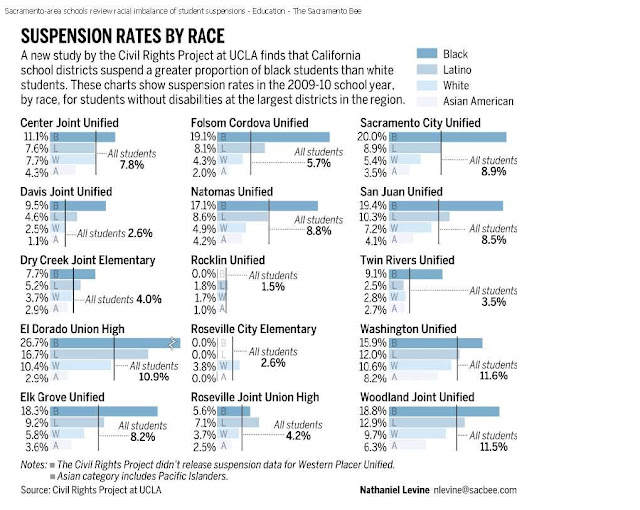
This is a true story. In my first year on the school board, while attending a state sponsored convention in Tampa in 2007, I attended a break-out session on “The Achievement Gap”. The lecturer in the small room had a PowerPoint presentation and some handout materials detailing his data analysis indicating that in the districts he studied- White student achievement was typically higher than Hispanic student achievement, and Achievement among African American students was typically below the Hispanic level. He went on to frame his conclusions and a group discussion ensued on how to narrow the “gap.” Before the group could dive too deeply into how the public school system was somehow potentially shortchanging Hispanic and African American students-- I raised my hand and asked, “Where are the Asians detailed in your analysis”----then the room went quiet like a scene from one of those old E.F. Hutton commercials. Then came the gasps and a few muted chuckles. I did not realize I had committed a faux pas by

This is a true story. In my first year on the school board, while attending a state sponsored convention in Tampa in 2007, I attended a break-out session on “The Achievement Gap”. The lecturer in the small room had a PowerPoint presentation and some handout materials detailing his data analysis indicating that in the districts he studied- White student achievement was typically higher than Hispanic student achievement, and Achievement among African American students was typically below the Hispanic level. He went on to frame his conclusions and a group discussion ensued on how to narrow the “gap.” Before the group could dive too deeply into how the public school system was somehow potentially shortchanging Hispanic and African American students-- I raised my hand and asked, “Where are the Asians detailed in your analysis”----then the room went quiet like a scene from one of those old E.F. Hutton commercials. Then came the gasps and a few muted chuckles. I did not realize I had committed a faux pas by
Subscribe to:
Posts (Atom)