|
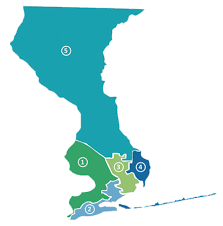
| Like the Horror Show Creature that refuses to die--it appears as if the failed language from last year's election bill, the language that would make all single-member district commissioners elected in 2020 statewide run for re-election again two years early in 2022, has been resurrected again for the upcoming legislative session! Just imagine it: All 5 Escambia Commissioner's Districts up for election/re-election simultaneously in 2022! fun times, fun times! |
The answer is yes, we might possibly all be running together next year. Imagine that? Gomer Pyle might say: "Surprise, surprise, surprise!" --It's all because the horror show monster we thought we killed last year is stirring and moving. Just like Jason Voorhees who has died and come back to life to wreak havoc, destruction, chaos, and death in 9 subsequent installments of "Friday the 13th"--it looks like the monster's not dead and we all might be campaigning again two years sooner than we thought.
This is because an onerous new bill is in "drafting" over in Tallahassee. It appears that it will be filed iminently, as the draft made yesterday's deadline for legislation to be filed.
A bird whispered in my ear yesterday that this could be coming, again. A similar provision was attached and then subsequently deleted from last year's session's elections train bill. I've verified that this is all true. The bill sponsor feels it is entirely appropriate. "We have to run next year after our redistricting-why shouldn't they [commissioners statewide that serve in single-member districts]..was his response when asked about it yesterday by a third party.
So here we go again! 😁
Essentially--i'm told this bill is being crafted based upon last session's failed provision that requires County Commissioners who serve in single-member districts to run for re-election again in the first election post redistricting even when such a commissioner is only part way through a currently earned/won, constitutionally defined 4-year term. It slices terms in half if it is passed ---and also if it passes legal muster (more on that thorny issue, below).
Ostensibly--the theory is this: If a district is re-arranged after an election, a potentially significant number of voters "may" spend several years represented by a commissioner for whom they did not vote.
Seems like a fair enough argument, on its face.
But wait---if you make a commissioner who fairly won a four year election in a district that had to give up population due to growth-------and if such a commissioner loses the subsequent election 2-years into his 4-year term--wouldn't that serve to disenfranchise those who voted to elect this commissioner in the first place? Wouldn't it be a "taking from the commissioner who won a 4-year term, not a 2-year term?" Wouldn't it serve to actually disenfranchise more voters than the smaller number (if any) who may have been "re-districted" into a commissioner's district for whom such voters did not vote? I know it's confusing. I know it is a lot to digest.
But examined differently--the talking point about not allowing someone to serve who some or most constituents didn't vote for can be systematically rebuked and decimated quite easily. Our nation was led by President Bill Clinton from 1993 to 2001--a guy who never won a majority of the nation's popular vote. Neither 1992 nor 1996. In both of those cases--he simply won a plurailty of the popular vote and then subsequently the electoral college. Betcha didn't know that, did you?
And there are other examples.
People move all the time and are represented by folks they didn't vote for.
Close elections leave up to 49.9% of voters under the leadership of those that they didn't support.
Office holders resign and sometimes years of an officeholder's term are filled by a political appointee (hack, potentially) for whom NOBODY voted....
So yeah--that failed argument is a feckless smokescreen. But bad ideas sometimes come out of agenda pushing and make it to the finish line in state legislatures---even Tallahassee (gasp).
Ofterntimes the finish line doesn't line up with the legislature's chambers or the governor's mansion --it winds up at a courthouse chamber where a smart judge looks at it for what it is and strikes it down. (thankfully we do have checks and balances still, after all. for now. we hope. )
This idea is a bad one, and if passed by the legislature (50-50 shot--if it gets traction in the Senate)--it will face an immediate challenge in the court.
Because numerous and ominous are the constitutional ramifications of such a reckless idea.
Simpletons will exclaim "But the State Senators have their terms cut in half and have to re-run in after redistricting--so should county commissioners!!" But wait--that concept of running after a redistricting is a known fact of reality to every senator already----as it is codified in the constitution, (Article III, Section 15, here)
County Commissioners have no such language stipulating they be re-elected two years early after each decennial redistricting--so such a change, in many peoples' opinions, would necessitate a change to the constitution to enact. here (article VIII, sec. 1 (e)).
So why make this change this year? That's a question I have heard.
This past year with COVID-19 mandates and lockdowns--several counties and many school boards found themselves at odds with Tallahasse leadership.
Perhaps this is a way to change the composition of some boards? This is just a guess on my part, but maybe it is true?
Maybe some legislator doesn't like some county official and wants to exert pressure?
Could it be some sort of juvenile "Sabre rattling?"
Oh, I know, I know! It's those (XXXXX's) over in Brevard County!!
Maybe some legislator that wants to run for county commissioner in 2022 when he terms out doesn't want to wait until the current commissioner in that district (coincidentally a long-serving incumbent in a single-member district) leaves office in 2024? Maybe this legislator wants to force the issue in 2022?
Who knows the real reason--right?
But whatever it is-- it ain't a slam dunk. Not by any stretch. There's no certainty this would pass. It would create a lot of gnashing of teeth statewide, and would face resistance.
And if it did pass--it would invite chaos, consternation, and a host of litigation and more burdens on Supervisors of Elections around the state---not to mention the check writers who fund campaigns locally--they wouldn't like this I'd venture to guess......
Would it be GOOD if it passed? Well, I guess that depends upon whom it is you are asking.
If you ask that eccentric tuna fisherman who nets and kills 100 porpoises for every one tuna he harvests-----yeah HE might like this new idea in Tallahassee.
Similarly--if you asked the banana republic commando squad that killed 27 hostages in order to take the one kidnapper "into custody"--yeah, those guys might agree.
But most of us who are watching this scenario unfold see it, know it, and smell it for what it is.

.jpg)